
The notion of employing nuclear weapons against Ukraine occupies the thoughts not only of military strategists or individuals involved in this domain.
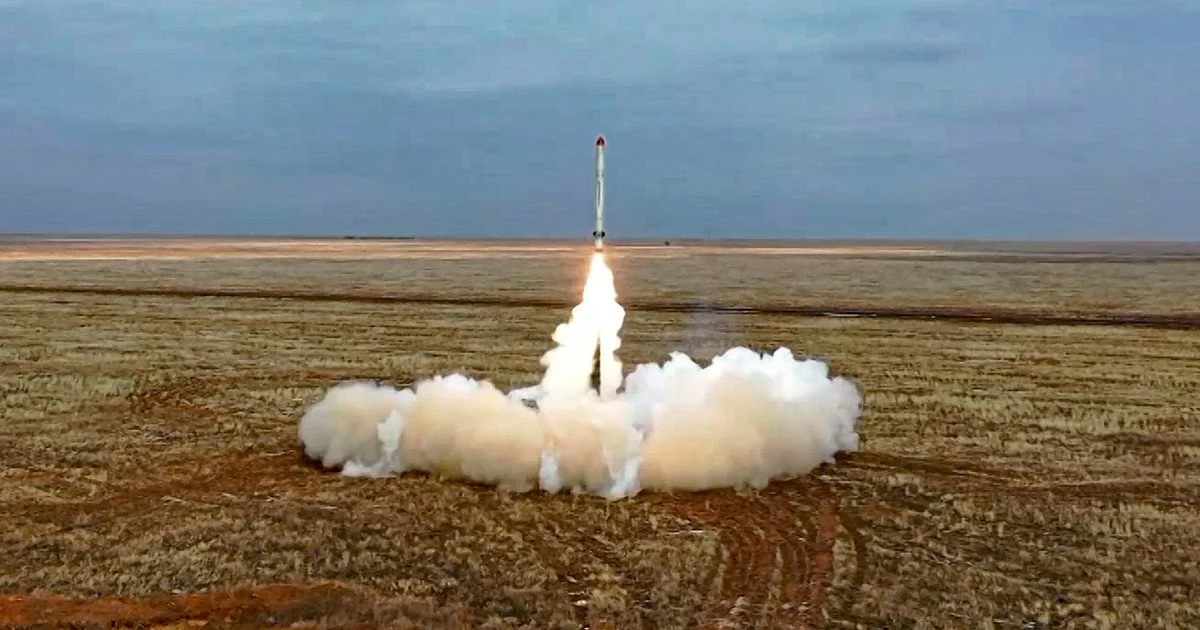
The possibility of a so-called “nuclear apocalypse” remains real / © Associated Press
The Russians are striving with all their might to retain occupied territories and show no inclination to withdraw from Ukraine. This is precisely why Russian President Vladimir Putin has once again resorted to blackmailing the entire world and Ukraine.
It is difficult to ascertain when this might occur or what type of weaponry might be deployed. It is not inconceivable that an attack on Ukraine could follow a predicted failure by the Russian Federation in its mobilization efforts. When the Armed Forces of Ukraine once again vanquish newly formed units, Putin might unleash his perceived trump card – a nuclear strike.
TSN.ua delves into the potential timing of Putin’s decision to use nuclear weapons and the perspectives of politicians, military personnel, and “experts” on this matter.
In light of Ukraine’s intensifying strikes on military and infrastructure targets deep within the aggressor state, it has recently become fashionable to discuss the possibility of the Kremlin resorting to extreme measures and responding to Ukraine with a nuclear attack.
The discourse has reached a point where even Svitlana Pavletskа, the wife of former Foreign Minister Dmytro Kuleba, has begun contemplating this on the YouTube platform. This is, in reality, not a very humorous development.
What Kuleba and His Wife Said
According to Kuleba, the preparations for the deployment of nuclear weapons necessitate numerous procedures, with intelligence agencies closely monitoring and identifying these changes. He explained that in the event of Russia striking Ukraine, the focus would be on the use of tactical nuclear weapons, whereas the United States employs strategic ones.
“There are two methods of delivering a nuclear strike. The first involves a missile launch, which lands on a ground target and detonates. In such a scenario, the damage radius is smaller, but the level of nuclear contamination is higher. The second method is when a missile is launched and detonates in the air above the target. This increases the area of destruction, but reduces the intensity of radioactive fallout. Therefore, if a missile with a nuclear warhead is intercepted by an air defense system and detonates in the air, the blast wave will still affect the intended area. The strength of this wave depends on the altitude at which the explosion occurs,” Kuleba elaborated.
He pointed out that Russia would most likely target a military infrastructure site or a position in the combat zone rather than a city or civilian population.
Meanwhile, Kuleba’s wife, Svitlana Pavletskа, who is unlikely to possess expertise in military matters, described a potential nuclear strike as “almost a victory for Ukraine.”
Specifically, she stated that the use of nuclear weapons is improbable, as it is not a tool for “finishing off” an opponent but rather for self-preservation. She also expressed the opinion that in such a scenario, the likelihood of strikes on decision-making centers remains low.
“If he resorts to this, it will signify that we have already nearly won. Otherwise, why would he strike? Nuclear weapons are used to save oneself, not to annihilate another. Correct?” Pavletskа inquired.
Why a Nuclear Strike is a “Positive Scenario”
Pavletskа’s statements are merely the “tip of the iceberg.” Andriy Dligach, co-founder of the Center for Economic Recovery, has described a “nuclear strike on Ukraine as a positive scenario that will accelerate the end of the war and the disintegration of Russia.”
Dligach’s reasoning is based on the premise that the Kremlin’s deployment of nuclear weapons would result in Russia’s complete international isolation. No country in the world, not even those currently maintaining neutrality, could afford to ignore the act of nuclear aggression. This would lead to immediate and total global isolation of the Russian Federation, including from China and Global South nations.
Furthermore, he believes that a nuclear strike would provoke an immediate military response from NATO countries, thereby hastening Russia’s military defeat on the battlefield. According to the expert, Putin’s regime simply would not survive such a scenario, as internal centrifugal forces within Russia would gain powerful momentum.
Network Reaction
Political blogger and expert Oleksiy Holobutskyi shared ironic posts on his social media regarding Svitlana Pavletskа’s musings on the use of nuclear weapons against Ukraine.
“The experts we deserve: N’joy intimate goods store owner Pavletskа reflects on the prospects of a nuclear strike,” he wrote.
A lively discussion ensued under the expert’s post. Some users did not quite understand why Kuleba and Svitlana had raised this topic at all.
Here’s what people are saying:
-
Couldn’t they have discussed this at home instead of publicly embarrassing themselves?)))
-
We don’t even deserve this.
-
Everyone has the right to change professions. Zelenskyy can, but Pavletskа cannot?
-
The wife interviews her husband!!!! A brilliant scenario!!!!)))
-
It’s just a jumble of words and an unintelligent appearance. I won’t even mention Kuleba)
-
Our Confucius! Did Confucius have a wife?
Jokes aside, let’s consider what serious individuals actually say about the threat of a nuclear strike on Ukraine.
Oleksandr Syrskyi, Commander-in-Chief of the Armed Forces of Ukraine
Commander-in-Chief Oleksandr Syrskyi believes that Putin is unlikely to dare to actually use this type of armament. Syrskyi recalled that Ukrainians have been threatened with nuclear weapons since the beginning of Russia’s full-scale aggression. The Ukrainian military continuously takes this into account.
“But we understand that this argument would place Putin entirely outside the law globally. Because there is a tribunal,” the general explained.
Therefore, the Commander-in-Chief of the Armed Forces of Ukraine thinks that the Russian dictator will not resort, at least for now, to steps that would involve striking Ukraine with nuclear weapons.
Kyrylo Budanov, Head of the Main Intelligence Directorate of the Ministry of Defence of Ukraine
Fears regarding a Russian nuclear strike, which are circulating in Ukraine, are unfounded. However, the Russian arsenal continues to pose a serious threat, according to the Head of the Main Intelligence Directorate Kyrylo Budanov.
“But this is, first and foremost, a matter of political will. I have not seen any signs of preparation for a nuclear strike. If there were, I would know,” the head of the Main Intelligence Directorate noted.
Military Analyst Michael Clarke
Clarke doubts that Vladimir Putin would risk being labeled “the greatest war criminal of the 20th or 21st century” by using nuclear weapons during the offensive in Ukraine.
“Unless nuclear weapons are used solely as terror… to drop them on Poltava or Kharkiv… to kill as many civilians as possible,” the expert stated.
General Serhiy Krivonos
Krivonos stated that Ukrainian and allied intelligence agencies continuously monitor the movement of Russia’s nuclear arsenal, and the recurring threats involving the “Oreshnik” missile system are merely a tool of psychological pressure from the Kremlin.
According to Krivonos, a single Russian nuclear strike would not resolve the situation for the Russian Federation, as Moscow must consider the global community’s response. Therefore, the deployment of “Oreshnik” represents a significantly different level of risk for Russia than mere intimidation.
Deputy Commander of the Third Assault Corps, Lieutenant Colonel of the Armed Forces of Ukraine Maksym Zhorin
Zhorin does not rule out the possibility of a tactical nuclear strike on Ukraine. He suggests that such a plan has been on Putin’s table since the very beginning of the full-scale war.
“The Russian army is suffering immense losses, and even minimal progress is extremely difficult to achieve now. Failing to obtain the desired results on the battlefield, the Russian Federation attempts to blackmail with what it can,” the officer said.
What Tactical Nuclear Weapons Russia Possesses
According to U.S. intelligence, Russia possesses approximately 2,000 tactical nuclear weapons. Its tactical nuclear warheads can be deployed on various types of missiles typically used for delivering conventional explosives, such as cruise missiles and artillery shells.
Tactical nuclear weapons can also be employed from aircraft and ships – as anti-ship missiles, torpedoes, and depth charges.
The United States reports that Russia has recently made significant investments in this weaponry to enhance its range and accuracy.
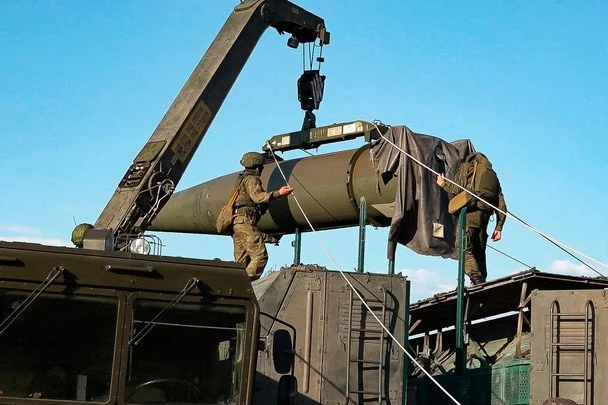
The Russian Federation possesses nuclear weapons / © Associated Press
Tactical nuclear weapons have never been used in conflicts.
Nuclear powers, such as the United States and Russia, have acknowledged that targets on the battlefield can be destroyed just as effectively with modern conventional munitions. Furthermore, no nuclear-armed nation has yet been willing to risk initiating a nuclear war by employing tactical nuclear weapons.
However, Russia may be more inclined to utilize smaller tactical weapons than larger strategic missiles.
Background:
On December 5, 1994, the leaders of four countries – Ukraine, Russia, the United States, and Great Britain – signed the Budapest Memorandum. The English version of this document contained assurances to Ukraine that the other three countries would respect its territorial integrity. The Memorandum marked the conclusion of the process by which Ukraine relinquished its portion of the Soviet nuclear arsenal.
”
Comments Sort: New Old Popular Send