
A new military concept focuses on the “functional defeat” of the aggressor through “surgical” strikes on the economy, logistics, and factories, rather than heavy ground offensives.
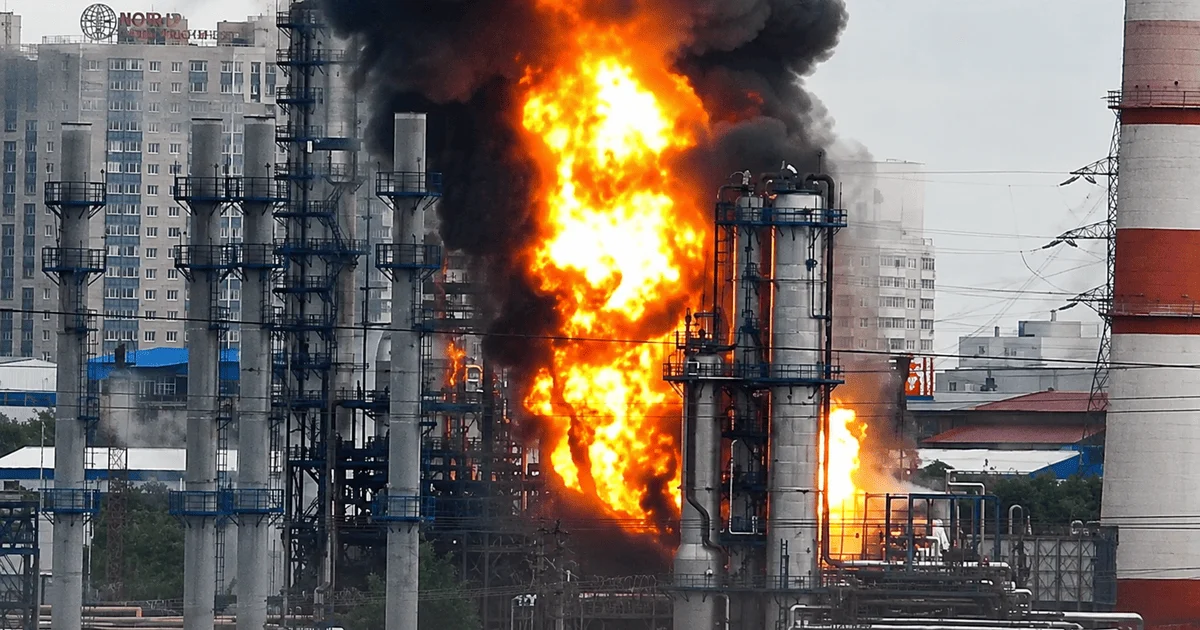
Fire at a Moscow refinery after an attack on June 16 / Archive photo / © Exilenova+
The Ukrainian military command has developed and begun to implement a new comprehensive strategy for victory, which is based on pinpoint destruction of the enemy’s economy and logistics instead of exhausting infantry assaults. This ambitious plan envisages critically weakening the adversary’s military potential through massive strikes on energy infrastructure, supply lines, and key high-tech weapons manufacturing plants.
This is reported by Foreign Policy.
“Strategic Neutralization” of the Enemy
In recent months, Kyiv’s approach to conducting combat operations has undergone a fundamental transformation. Instead of grinding down forces at the cost of huge losses, as was the case during the summer counteroffensive of 2023, the new concept has been dubbed “strategic neutralization” of the aggressor’s military potential. Former Minister of Defense of Ukraine Andriy Zagorodnyuk explains its essence using the example of the Russian Black Sea Fleet: it was not destroyed to the last ship, but successfully driven out of Sevastopol using naval drones and turned into a helpless structure.
This same model of “functional defeat” is now being applied in other areas. Mykhailo Gonchar, President of the Center for Global Studies “Strategy XXI,” notes that the main goal is to cut off the revenues of the Russian military budget, create a fuel crisis, and surgically disrupt the supply chains of the defense industry. This is intended to halt the production of high-precision weapons and preserve the lives of Ukrainian soldiers as much as possible.
Strikes on Refineries and a New Arsenal
Particular attention in the new strategy is paid to the relentless destruction of Russian oil refineries, fuel depots, and pipelines. The situation for the aggressor has become so critical that Russia is forced to import gasoline from India and has imposed a strict ban on the export of gasoline, aviation fuel, and, more recently, diesel fuel. According to the Financial Times, the statistics of strikes are impressive:
-
Since the beginning of the current year, Ukraine has carried out 194 strikes on Russian oil refineries.
-
This figure is 11 times higher than the number of attacks in the same period of 2025.
-
More than half of the regions of the Russian Federation have officially announced a shortage of fuel, restrictions on its sale, or rationing for the civilian population.
The success of this long-range campaign is ensured by the development of entirely new weapon systems. Ukrainian forces have begun using Hornet strike kamikaze drones equipped with artificial intelligence to evade electronic warfare systems. A real breakthrough was the appearance of Flamingo cruise missiles with a range of almost 2900 kilometers, which recently seriously damaged Russia’s largest oil refinery in Omsk – over 2400 kilometers from the front line. In addition, Ukrainian engineers are working on creating drones that will expand the front-line “kill zone” for infantry from the current 32–40 kilometers to over 64 kilometers.
Isolation of Crimea as the Key to the Fall of Putin’s Regime
The key geographical target of the plan is the Crimean Peninsula. The Ukrainian military is methodically cutting off supply lines of ammunition, fuel, and food to the enemy forces in the occupied territories. According to the forecasts of one of the combat officers of the Armed Forces of Ukraine, the peninsula can be completely cut off by the end of this summer. If Crimea loses its logistical significance, it will become extremely difficult for Russians to hold positions in parts of Kherson and Zaporizhzhia regions.
Alina Frolova, Deputy Head of the Center for Defense Strategies, notes that the political consequences of the de-occupation or complete isolation of Crimea could be devastating for the Kremlin dictator. Many experts in Kyiv draw direct parallels between Vladimir Putin and Russian Tsar Nicholas I, whose 30-year reign ended in absolute collapse in 1855 precisely because of the humiliating defeat in the Crimean War.
Despite these optimistic steps by Ukraine, the aggressor still possesses enormous resources, including ballistic missiles and a large human potential. However, Kyiv’s new strategy is to continue methodically tightening the noose around the Russian economy and logistics until the system collapses from within.
Recall, an expert explained the new strategy of the Armed Forces of Ukraine regarding Crimea. Currently, the focus is on long-term missile and drone strikes on the occupied peninsula, which are intended to make the stay of Russians on the peninsula unbearable, explained Kostiantyn Kryvolap.
Comments Sort: New Old Popular Submit