
Scenes of the sea stained red with blood have ignited widespread outrage among animal welfare advocates globally.
The Faroe Islands have witnessed another bout of the traditional cetacean hunt, which resulted in the coastal waters turning crimson from the spilled blood.
This is reported by LADbible.
Each year, this practice sparks heated debates between local inhabitants, who view it as an integral part of their cultural heritage, and animal protectionists, who decry the event as a brutal massacre.
The tradition, known as “grindadráp” or simply “grind,” has existed since the 9th century. For over 80 years, its execution has been governed by the authorities of the Faroe Islands, an autonomous territory within the Kingdom of Denmark.
During such hunts, specially trained boatmen locate pods of pilot whales and dolphins in the open sea and herd them towards shallow waters near the shore. There, the animals become trapped, after which they are killed by local residents.
According to available data, an average of about 700 cetaceans perish annually during the “grindadráp.”
Photographs and videos circulating on social media depict dozens and hundreds of deceased animals laid out along the coastline. Due to the large volume of blood, the water near the coast takes on a deep red hue.
Despite international condemnation, the islanders continue to defend the tradition. They emphasize that the hunt is a significant component of local culture and provides communities with meat and food resources.
Concurrently, conservationists draw attention to the unique characteristics of the animals themselves. Pilot whales are highly social mammals. Females can live up to 60 years, while the lifespan of males is typically shorter by approximately 15 years.
Like dolphins, they form strong social bonds within their groups and are capable of experiencing intense stress when facing danger or the loss of group members.
Following the release of this year’s hunt footage by activist Páll Asbjørnsson Justesen on social media, users posted thousands of indignant comments.
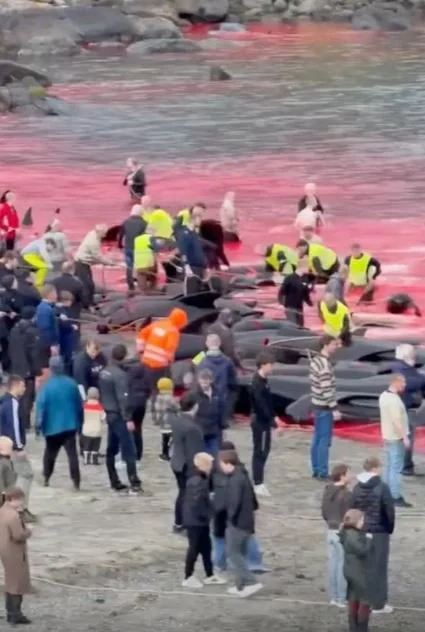
Sea in the Faroe Islands / © Facebook
Many were shocked not only by the killing of the animals but also by the fact that entire families, including children, often observe the process.
“What a horrific sight, this must be the worst place on this planet, full of wicked and backward people who take pleasure in killing gentle innocent creatures,” one user wrote.
Another commentator remarked, “What an evil world humanity has created for animals.”
Yet another user added, “Unbelievable!!!! This is a staggering tragedy!!!!!!!!!! There is nothing good in this destruction of life!!!!! Shame on all these people!!!!!”
Among the comments, there were also calls to prohibit such practices at a legislative level.
Despite decades-long campaigns by international environmental organizations and numerous protests, the “grindadráp” remains a legal practice in the Faroe Islands.
The authorities regulate the hunt through a system of rules and restrictions. Specifically, the use of harpoons and spears is prohibited, and quotas are set for the capture of certain dolphin species.
However, animal welfare advocates are convinced that such measures do not resolve the core issue.
Representatives of nature conservation organizations emphasize that regardless of the method employed in the hunt, the animals experience extreme fear, stress, and suffering prior to their demise.
This is precisely why, with the commencement of the “grindadráp” season each year, discussions surrounding this tradition gain momentum once more, dividing public opinion between proponents of preserving cultural heritage and those demanding a complete ban on such hunts.
We remind you that an 18th-century ship laden with artifacts was discovered at the bottom of the sea.
Comments Sort: New Old Popular Submit