
After the defense of Mariupol in 2022, “Azov” is again focusing its attention on the city, but now operating with drones and strikes on enemy logistics.
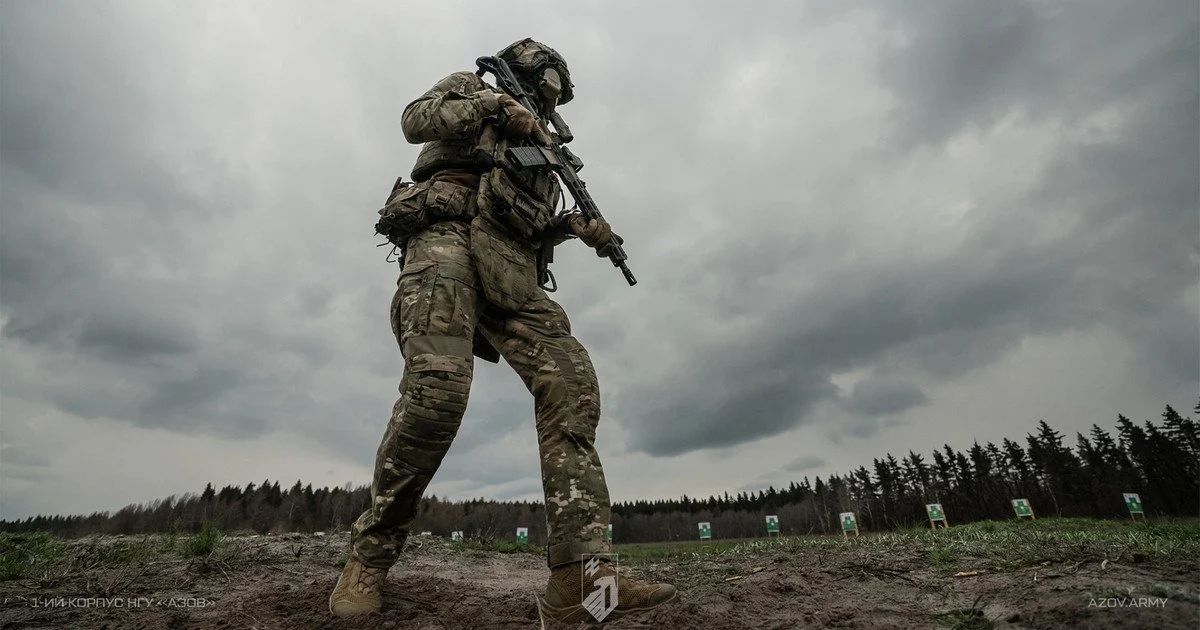
Azov soldier / © Azov
Following the 2022 defense of Mariupol, the reformed and expanded “Azov” unit is once again concentrating its efforts on the city and Russian logistics in the occupied territories. The unit is carrying out strikes on targets that aid Moscow in maintaining control over southern Ukraine and supplying its troops at the front.
This is reported by Reuters.
Last week, drones from the First “Azov” Corps attacked a strategic seaport in Mariupol. The targets included electrical substations, repair facilities, and a sanctioned vessel. The attack resulted in a power outage at the port.
Reuters reports that it was able to verify the location of filming for a portion of the attack video released by the corps.
“Azov“ is preparing new operations
Colonel Arsen Dmitrik, Chief of Staff of the First “Azov” Corps, told Reuters that more such operations are planned. According to him, the unit aims to showcase its capabilities, technologies, and planning.
At the same time, Dmitrik acknowledged that dislodging the Russians from Mariupol, located approximately 120 km from the largely static front line, is a long-term objective.
“If it takes 20 years, we will spend 20 years planning, waiting, and preparing. But when the time comes, we must be ready. I believe we will retake it,” he stated.
Dmitrik believes it is “just a matter of time.”
Strikes on Mariupol and supply routes
The port attack occurred a few kilometers from the destroyed metallurgical plant, where “Azov” fighters and other Ukrainian soldiers held their ground during the 2022 Russian siege of Mariupol.
Prior to this, over several months, “Azov” had been targeting crucial roadways in the occupied Donetsk region, including areas around Mariupol. These actions are part of a systematic effort to disrupt Russian supply lines.
Videos released by the corps show drones attacking Russian military equipment on roads and highways around Donetsk. Another video from May 8th displays drone footage over the center of Mariupol and the damaged “Azovstal” plant.
“Azov is already patrolling its native city of Mariupol. From the air – for now,” the unit stated in a message.
Why Ukraine is striking Russian logistics
According to a drone officer from the corps, within the framework of Ukraine’s medium-range strike campaign, “Azov’s” primary goal is to interdict Russian cargo, especially fuel, shipments from Russia through key hubs, including Mariupol and Donetsk.
He noted that the constant movement of trucks on open roads is difficult to defend.
“It’s impossible to hide a fuel tanker. It’s simply unrealistic,” the officer said.
Among the routes targeted by Ukrainian forces are the M14 highway connecting Mariupol with Rostov in Russia, the H20 highway towards Donetsk, and the ring road around Donetsk.
Ukrainian forces are also intensifying strikes on logistical facilities along Russia’s occupied “land bridge” in southern Ukraine, which connects Russia with Crimea. This has already led to fuel shortages on the peninsula.
Impact on the Russian army
Franz-Stefan Gady, an expert at the Center for a New American Security, stated that “Azov’s” strikes have a cumulative effect rather than an immediate one. They compel the Russian army to disperse its equipment, take longer detours, and move more frequently at night.
Over time, this reduces the offensive pace that Russia can sustain on the battlefield.
Meanwhile, Russian forces continue their pressure in the Donetsk region, advancing towards Kostiantynivka, one of the critical nodes in the area’s “fortress belt.” Russian drones are also targeting Ukrainian logistics.
Despite this, Russia’s overall pace of advance has slowed in recent months, and Ukrainian forces have recaptured territory in certain sectors of the front.
Drones used by “Azov”
One of the corps’ key assets is the AI-assisted Hornet drone. It was developed by the American defense technology company Perennial Autonomy, owned by former Google CEO Eric Schmidt.
According to analyst Rob Lee, “Azov” operators have modified these drones by installing Starlink terminals to extend their initial 100 km range.
“Azov was responsible for many of the improvements to the Hornet,” he said.
Prisoner exchange remains a priority
Dmitrik stated that strikes on roads to and from Mariupol are intended to help achieve one of the key objectives: accelerating the end of hostilities and securing the release of over 700 “Azov” fighters from Russian captivity.
Ukraine insists on an “all for all” prisoner exchange as a central element of any peace agreement.
Corps Commander Denys Prokopenko previously stated that the liberation of his comrades is his personal priority and a “matter of honor.”
Today, “Azov” is formally part of the National Guard and is considered by analysts to be one of Ukraine’s leading units in drone warfare. According to the unit, the corps has expanded to include six brigades, a drone regiment, and a special forces unit, with a total strength of tens of thousands of military personnel.
Previously, it was reported that Russian “war correspondents” are sounding the alarm, as areas previously considered safe have turned into traps. Electronic warfare systems are proving ineffective against new drones, allowing Ukrainian forces, including fighters of the 1st “Azov” detachment of the National Guard, to freely destroy fuel trucks and military trucks near occupied Mariupol.
Comments Sort: New Old Popular Send