
Harvesting onions at the right time: how to determine the optimal period for it.
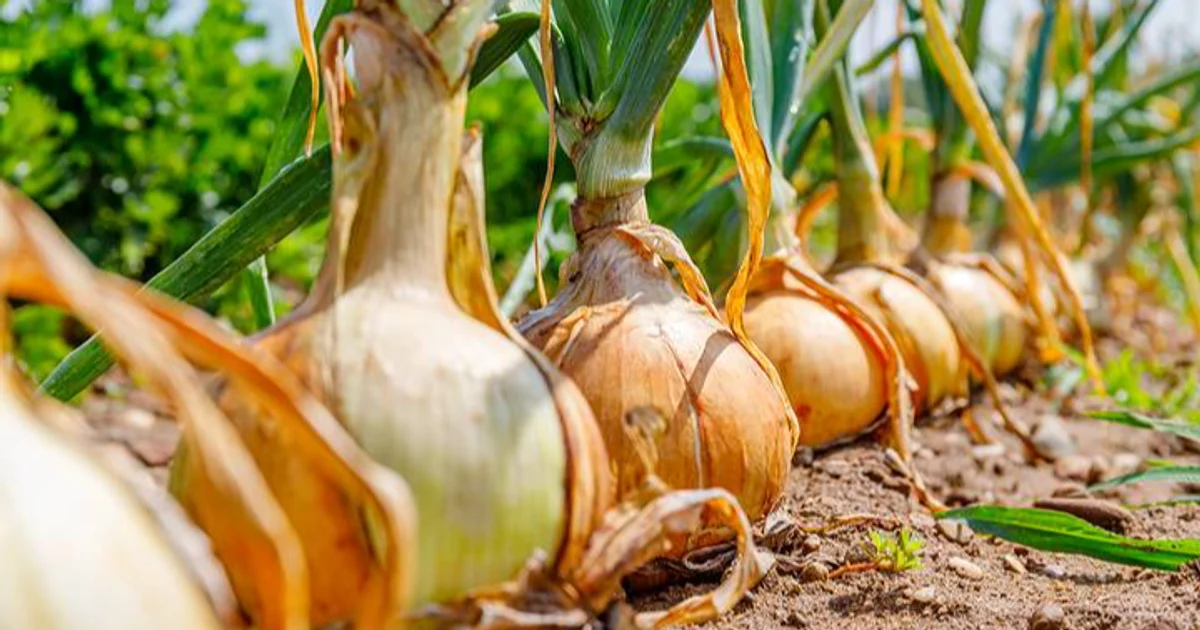
When to harvest onions
Gathering the onion crop is one of the most critical stages of the entire gardening season, as the duration of its winter storage directly depends on correctly determining the timing. To keep the harvest juicy, healthy, and flavorful until spring, it’s important to consider a combination of factors – from planting dates and weather to the plant’s physiological signs of ripeness. Typically, the mass harvesting of this crop falls in the second half of July and early August. It’s best to harvest onions when they have fully ripened naturally, but this process is simultaneously influenced by several important factors that each gardener must assess individually.
Key Factors Influencing Onion Harvest Timing
The primary role in ripening is played by the current weather conditions. The situation varies greatly across regions: in some places, continuous heavy rains significantly slow down the process, while in others, there is no precipitation at all.
Besides the weather, the species and varietal characteristics of the crop itself, as well as the exact time of its planting in the soil, are of great importance. The earlier the onion was planted, the sooner it’s time to harvest the mature crop. Overwintered onions, planted in the fall before winter, are harvested a full month earlier than regular spring-sown onions. By early July, overwintered beds yield large and firm bulbs. In contrast, leeks, due to their very long growing season, are harvested later than all other types, as they continue to actively gain mass until the end of September.
Main Signs of Onion Readiness: When to Harvest
To unerringly determine the moment when onions can be safely removed from the garden bed, one must observe several characteristic physiological signs of the plant.
-
Neck condition. It becomes soft and begins to bend easily under its own weight. However, for full ripeness, it should not just be soft but also sufficiently thin. If the neck remains thick and firm, it indicates that the process is incomplete, and such a crop should be left in the ground longer.
-
Outer scales. They visibly dry out and acquire the color characteristic of their variety: if the variety is yellow, the scales turn yellow; in purple varieties, they take on a purple hue; and in white varieties, they become clean and white.
-
Leaf behavior. The foliage gradually begins to yellow and widely lie down on the ground. When the tops fall over on their own, it signifies that the softened neck can no longer hold the stem upright.
-
Bulb skin. It becomes dry, starts to peel characteristically, and the protective scales easily separate from the bulb. The plant should also have reached its normal varietal size.
Harvesting too early will result in an immature onion with weak scales that cannot protect it from fungal spores or prevent moisture loss. A firm, juicy neck contains excess sap and will not dry properly for long-term storage.
On the other hand, delaying the harvest, especially during prolonged wet weather, poses a risk of disease-prone onions actively rotting in the ground due to bacterial and fungal infections.
How to Speed Up Onion Ripening During Prolonged Rains
When the summer is excessively rainy and moisture covers the ground, ripening processes can be artificially accelerated using proven agronomic steps.
One such method is manually laying the foliage on the ground in neat rows, all in one direction. This forcibly halts the growth of the greens and compels the plant to transfer all its sap to the bulb.
In small garden beds, each onion bulb can be further disturbed by hand, meaning it’s lightly pried up in the soil without being fully removed. After this, the plant begins to absorb nutrients from the root system and the drying foliage much faster and more effectively.
If dry weather prevails in the region for an extended period and the onions have been watered artificially, then any irrigation of the beds must be completely stopped exactly two weeks before the planned harvest. In cases where rains become heavy and continuous, a small plantation can be temporarily covered with polyethylene film. The covering should be done in such a way that rain does not fall directly on the onions, while maintaining through ventilation on both sides for free root respiration.
It is also very important to regularly loosen the soil around the plants. If, for example, there was heavy rain for half a day, then towards the evening, one should go to the garden bed and thoroughly loosen the soil between the rows to accelerate the evaporation of excess moisture and expose the bulbs to the soil for unimpeded access of warm sunlight.
How to Properly Harvest, Clean, and Store Onions
Onions should be dug up exclusively on a warm, clear, and sunny day, as moisture on the bulbs during harvesting significantly impairs their future storability. The plants should be carefully pulled out of the ground one by one. It is strictly not recommended to take several at once, as this can easily break the stem or seriously damage the onion bulb itself.
If the soil in the plot is very dense and heavy, the plants must be undercut with a fork to avoid damaging the lower part of the bulbs.
When the soil is excessively wet and a lot of dirt and mud remains on the bulbs, it should be removed exclusively by hand. It is strictly forbidden to knock the bulbs against each other, hit them on the ground, or against the edge of the garden bed to remove dirt, as any mechanical impact leaves hidden dents that later become the primary source of rot. For the same reason, no sharp objects or tools can be used for cleaning.
Immediately after pulling from the ground, the roots and stem are not trimmed. All harvested onions are first carefully spread in a single layer directly in the sun to dry well, and then transferred for thorough drying to a dry, warm, and always well-ventilated room, such as a home balcony, veranda, or attic.
After the harvested crop has completely dried, the stage of careful sorting begins. All damaged, damp, or partially rotten onions are set aside separately and discarded entirely. Such produce is completely unfit for consumption and should never be left with the general lot, as rot can quickly spread from diseased specimens to neighboring healthy bulbs.
For long-term winter storage, medium-sized onions are selected, as well as smaller bulbs, as they have the best natural storability. Conversely, the largest onions should be used first, as large produce spoils much faster.
Onions should be stored in containers that allow for breathing and free air circulation. Suitable options include spacious cardboard boxes, bags sewn from natural fabric, and sturdy woven baskets.
The optimal air temperature in such a dry and ventilated space should be consistently maintained between 15 and 20 degrees Celsius. Often, the harvest is kept in attics, where onions overwinter excellently and are stored without problems until spring. Throughout the winter period, the stock must be periodically stirred, moved, and carefully sorted to completely eliminate the appearance and spread of rot.
Leeks have a distinct storage requirement. Unlike bulb onions, they should be kept exclusively in a cool place – a cellar or refrigerator, as their fresh storage life is quite limited, lasting only a few weeks. For long-term preservation of leeks throughout the winter, it is recommended to wash them thoroughly, chop them into neat rings, and freeze them in airtight bags.
Comments Sort: New Old Popular Send