
The last wild specimen of this plant precariously clings to the steep rock face on Robinson Crusoe Island. Scientists have initiated a rescue mission to collect seeds and prevent the unique species from disappearing forever.
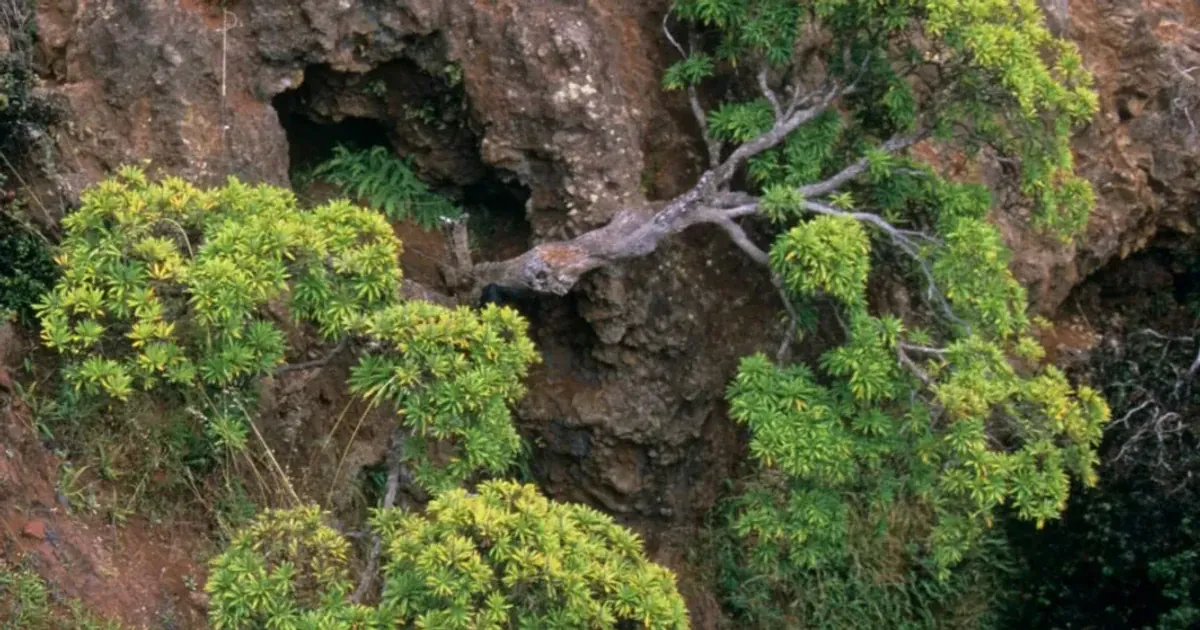
Dendroseris neriifolia Photo by Royal Botanic Garden Edinburgh
Scientists have embarked on a true race against time, desperately trying to save one of the rarest plants from complete extinction – the Chilean dandelion tree (Dendroseris neriifolia). Researchers are collecting seeds from the sole surviving specimen in the wild, which has literally anchored itself to a sheer cliff on Robinson Crusoe Island, part of the Juan Fernández Archipelago off the coast of Chile.
Futurism, citing the Royal Botanic Gardens, Kew, reports on this unprecedented rescue operation by botanists.
“Plant Galapagos” and the Species’ Value
The Dendroseris neriifolia, also known as the cabbage tree or tree chicory, is a true botanical marvel. The Juan Fernández Archipelago itself is often referred to by biologists as the “Plant Galapagos” because, due to its isolation, a unique flora has developed there that is found nowhere else in the world.
Although the dendroseris is a large tree, it actually belongs to the Asteraceae family and is a distant relative of the common dandelion or chamomile. It is a striking example of so-called “island gigantism” – an evolutionary process where small herbaceous plants, landing on an island without competitors, evolve over millennia into mighty trees.
Studying such endemics provides geneticists with invaluable information about rapid adaptation mechanisms, which can be utilized in breeding new, climate-resilient agricultural crops.
Why the Tree Is Falling Towards Extinction
The species has been severely impacted by habitat loss and the invasion of alien species. At one time, early explorers brought goats and rabbits to the archipelago, which virtually devoured the young shoots of these unique trees down to the root.
This is a classic ecological disaster: similarly introduced herbivores have destroyed entire ecosystems on the actual Galapagos Islands, Saint Helena, and in Australia, where the native flora simply lacked thorns or poisons to defend against such “guests.”
Furthermore, aggressive weeds and shrubs (particularly introduced blackberries) have suffocated the native plants. Today, the tree is forced to “huddle” on rocks inaccessible to animals, but global warming threatens its complete destruction.
Failed Attempts and the Last Hope
By 1980, after a sharp decline in population, only seven wild specimens of this tree remained. Employees of the Juan Fernández Archipelago National Park attempted to restore the species in the 1990s, but these efforts proved futile. Attempts in the early 2000s to reintroduce artificially grown plants back into the wild also failed. The main problem lies in genetic depletion and the extreme vulnerability of seedlings to the slightest changes in temperature or pests.
During the latest operation, using a giant net, ecologists managed to collect 29 seeds. X-ray analysis revealed that 25 of them are potentially viable. Seven young saplings have already been successfully rooted.
There is no room for error, as besides the tree on the cliff, only one adult artificially grown specimen remains in the world at the VerdeNativo botanical garden in Chile.
“This is a race against time. This international collaboration to support the last surviving specimen may prevent the extinction of a species that represents a unique lineage with its own natural history,” emphasizes botanist Diego Pennenkamp from the botanical garden.
We remind you that scientists have discovered a new way to predict volcanic eruptions. Trees have been observed to suddenly “green up” intensely, which could be a danger signal.
Comments Sort: New Old Popular Submit